Charting a New Course: IT Governance Brings Order and Transparency to Financial Services Team
Defining and implementing IT Portfolio Management and governance frameworks has been a core service that Vizionara team members have been involved with since their days as practitioners in large corporate IT environments. We applied those same learnings and principles for a leading financial services firm recently to support technology prioritization, optimize resource management, and increase visibility to the value being delivered by the organization amongst the critical C-suite stakeholders.
The Obstacle
The IT organization was grappling with resource allocation problems and a fragmented approach to project management. Central to its operational challenges were limited visibility across its portfolio of IT projects, inefficient decision-making processes and multiple, competing tracking systems. IT was spending too much time on administrative fire drills and too few resources on critical projects, leaving stakeholders unable to gauge the status of their projects and lacking confidence in the organization.
Having worked with our team members previously, the company’s CIO turned to Vizionara to stop the organizational chaos, bring order and consistency to IT delivery and increase confidence among business stakeholders.
Our Approach
We began by doing a three-week assessment of the current IT operations to get an organizational overview. This included talking to a broad cross-section of IT members and business stakeholders in order to get a clear picture of what would reduce the friction in their existing environment.
Team Member Feedback
After a quick round of interviews, we found that IT project management was siloed and inconsistent. There were many different ways to keep track of IT projects, including spreadsheets and multiple Portfolio and Project Management (PPM) systems used at varying levels that contained disparate amounts of detail. Some projects weren’t written down at all but were being done under the radar. For recorded projects, team members weren’t sure what the process was or how to go about it. They were confused over what needed to be tracked, what qualified as a project, who had to approve it, who was working on what and how to determine available IT capacity.
Complicating the project management challenge was a wild-west-like proliferation of shadow IT across the enterprise, spun up when stakeholders in functional groups decided centralized IT was taking too long to respond or found a new product they wanted to adopt and only came to IT for single sign-on capabilities. IT, in turn, spent a lot of time trying to respond to such requests and attempting to track shadow IT projects, draining resources for traditional project work.
Defining Major Projects
Aided by a cross functional group of IT team members meeting regularly, we began forging a solution by creating standard terminology around what constituted a project. We weighed different team member perspectives on timeframes, scope and resource requirements. Once we had a definition, we then compiled data from major projects and priorities to establish the comprehensive portfolio of projects. One of the lessons learned during discovery was that more information could be gleaned by asking team members to confirm not only the projects they were working on, but also what else they were spending time on that wasn’t on the active project list.
Although basic information gathering, this often uncovered hidden initiatives that were draining resource capacity that were not necessarily priorities for the organization over all.
Implementing PPM Process and Tool
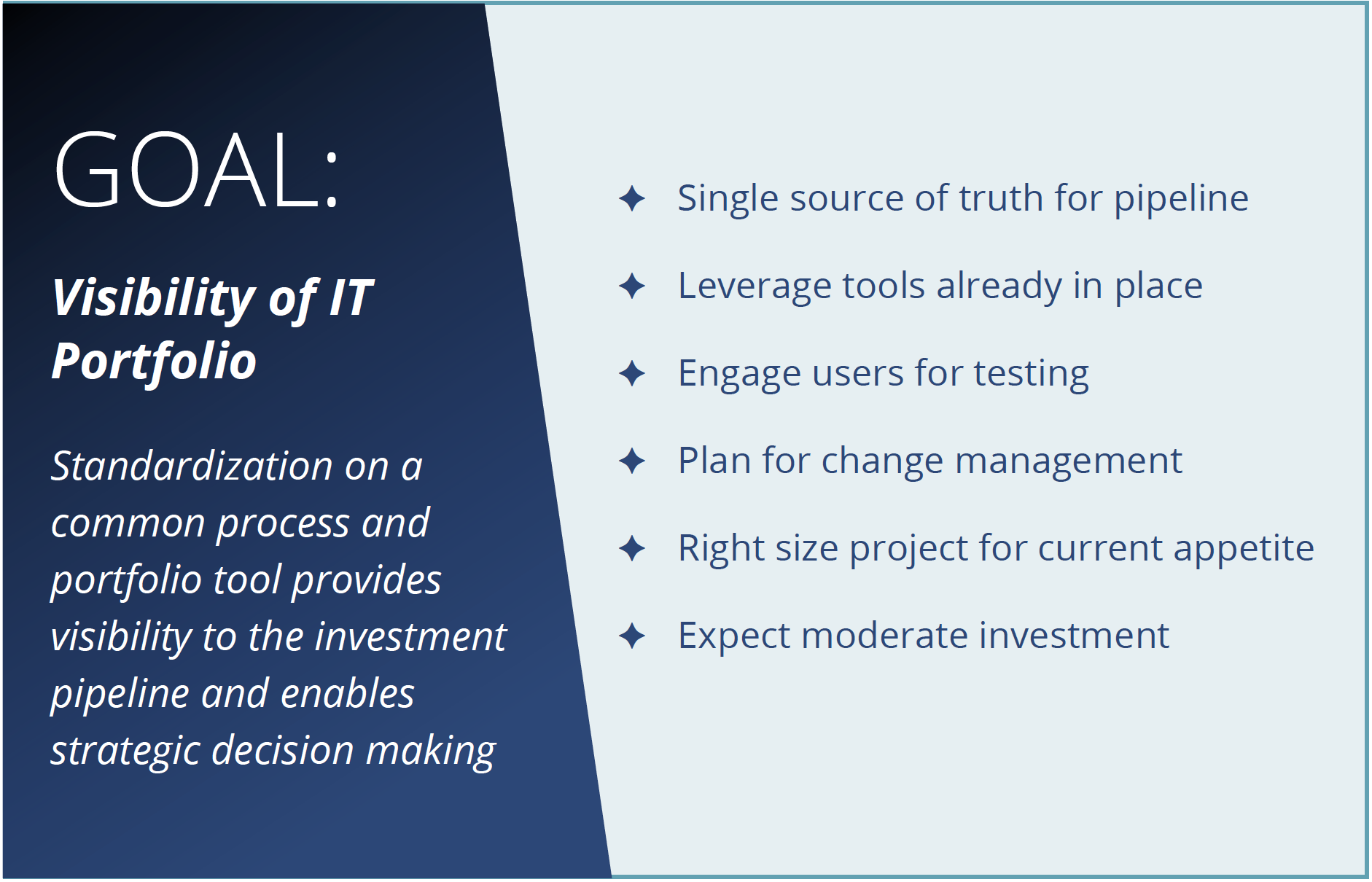
After a review of current and industry available tools, we then worked with the team to select a software vendor that would fit the organizations requirements for managing their portfolio of projects. This started with figuring out IT’s strategic goals and what reporting they needed to support it, including what information would be included, who would use it for what, and what features would best enhance the user experience. Drawing on Vizionara’s experience with a range of applications, we completed a software assessment of industry leading technologies for the team to evaluate. After selecting the best fit, Vizionara ultimately helped them implement it across the organization.
The Results
The tool the team selected, Planview, provides an easy way to look at projects in an apples-to-apples fashion, providing insights from project to executive level. It includes features that were important to the client, like creating executive level summaries so that there was transparency around the state of projects in the portfolio, which went a long way to building trust with their stakeholders and created a mechanism for future investment decisions.
IT now has a standardized tool for project management based on a common framework and a common list of projects. This allows IT to track projects and disposition new demand regardless of where it initiated. The cross functional team also came up with a pipeline process to screen new ideas and established a clear on-ramp to the process. The new framework also enabled more efficient resource management and improved productivity since the team members now knew the priorities and how their work aligned.
Next Steps
As the IT team charted a new course to optimize how they delivered value to the organization, their sights were set on the next step of the journey. As we transitioned the management of the process and tool to the client’s internal team, the Executive Board was already evaluating leveraging the new IT governance framework and expanding it for the broader cross-functional model to manage new capital investments across the enterprise.
After completing similar projects in a variety of IT organizations over the years, regardless of size and industry, we have found the key to success for effective Portfolio Management still lies in the process, governance, and culture. Great technology by all means provides a foundation, but without the strategic alignment, the willingness to collaborate and build a culture of managing the work as a collective portfolio versus a jumble of disparate projects, it’s hard to mature as an organization and reach your destination.